22 July 2026
API, RPA, RAG or an AI agent: how to choose the right mechanism
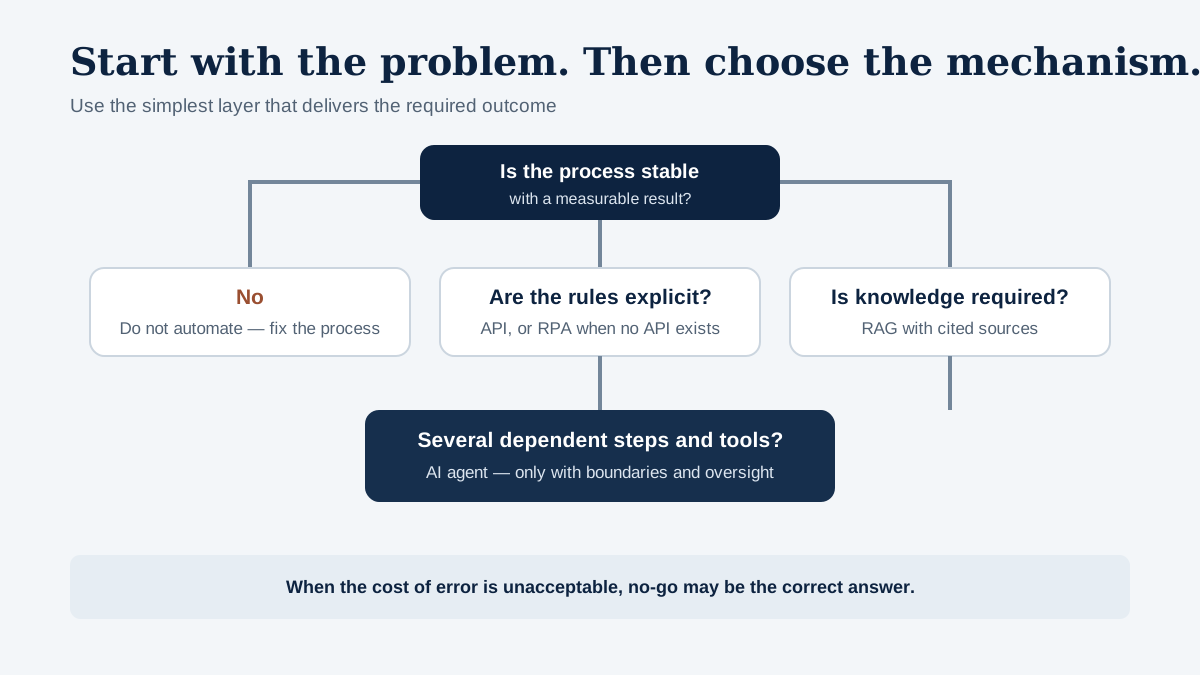
Choose an API when the rules are deterministic and the system exposes a stable interface. Use RPA for a stable legacy UI with no suitable API. Use RAG when answers must be grounded in documents. Consider an AI agent only when the task needs several context-dependent steps and controlled tools. If the process is unstable, the data is weak, the value is low or the cost of error is unacceptable, do not automate it yet. Fix the process or narrow the scope first.
That distinction matters more than model selection. Five approaches can look similar in a demonstration while carrying very different dependencies, operating costs and failure modes in production.
The short answer
| Situation | Simplest suitable mechanism | Main risk |
|---|---|---|
| Rules are explicit and a stable API exists | API | Incorrect rule or unhandled exception |
| Rules are explicit but a stable legacy system has no API | RPA | A UI change breaks the automation |
| Users ask questions about documents or a knowledge base | RAG | Wrong source, missing permissions or an ungrounded answer |
| The task has several dependent steps and uses tools | AI agent | Invalid action, excessive permissions or missing handoff |
| The process, data or risk boundary is not ready | Do not automate | Automation preserves disorder or scales an error |
This table does not replace process analysis, but it sets the right order. First check whether a deterministic mechanism is enough. Add generation and autonomy only when they solve a real limitation.
A six-question decision tree
- Does the process have an owner, a clear start and a measurable outcome? If not, stabilise it before automating.
- Can the rules be written without interpreting free-form language? If yes, start with an API or RPA.
- Does the source system expose a stable API? Choose API automation. If it does not, but its user interface is stable, consider RPA.
- Is the problem about finding and composing an answer from knowledge? Consider RAG.
- Must the system perform several dependent actions across tools? This may justify an AI agent with tightly bounded tools and permissions.
- Could an error cause material harm, while tests, logs and safe human takeover are missing? Stop or limit the experiment to read-only mode.
API: the default for stable rules
API automation is usually the best option when a process has an explicit input, rule and result. For example: retrieve orders with a given status, verify a condition and write the result to an ERP system. A language model adds no useful capability here. Code using an API is predictable, testable and less sensitive to cosmetic interface changes than a robot clicking through screens.
An API still has prerequisites. The source system must expose the operations and data you need. The integration must handle authentication, rate limits, errors and version changes. Deterministic does not mean maintenance-free; it means the expected behaviour can be described in advance and verified with tests.
If a straightforward integration solves the problem, adding an agent increases cost and attack surface without adding business value.
RPA: a bridge to stable legacy systems
Robotic process automation reproduces user actions in an interface: opening a screen, copying a value, clicking a button or downloading a file. It can be a reasonable choice when the rules are stable, no useful API exists and the legacy interface changes infrequently.
The trade-off is fragility. A renamed field, a revised layout or a different step order can stop the robot. RPA therefore needs monitoring, exception handling and an owner who responds to failure. If the application changes often, the maintenance burden may exceed the cost of building a proper integration.
Semitora does not provide RPA implementation services. RPA appears here because it is sometimes a simpler and more appropriate answer than RAG or an AI agent. If it solves the whole problem, adding generative AI would be unnecessary.
RAG: when answers must come from documents
Retrieval-augmented generation connects a language model to a controlled knowledge base. The system first retrieves relevant passages, then writes an answer grounded in those passages and can show its sources. It fits policies, manuals, contracts, product documentation and internal help desks.
RAG does not perform an end-to-end business process by itself. It answers a question or drafts content. Its quality depends on source data, document splitting, retrieval, permissions and evaluation. Our RAG for company knowledge bases page describes the production architecture, while data readiness for RAG covers the broader source criteria.
If the user needs a reliable answer with citations, start with RAG. Do not call it an agent merely because the interface looks like a chat window.
AI agent: when the system must plan and act
An AI agent combines a model, tools and task state to complete several connected steps. It might read a service request, check the CRM, retrieve a procedure, prepare a change and ask a human to approve it. This is more than an answer: the system can affect business applications and the process itself.
That autonomy makes sense when the step sequence cannot reasonably be expressed as one fixed rule and when context genuinely changes what should happen next. It also requires the strongest controls: least-privilege access, an allow-list of tools, limits, logs, approval points and a fallback. We describe those layers on the AI agents for business page.
An agent should not be shorthand for “more modern automation”. Use it only when planning capability creates more value than the additional risk and operating burden.
Do not automate: a valid decision
The correct answer is sometimes to postpone automation. Typical reasons include:
- the process has no owner or every team performs it differently;
- data is incomplete, stale or lacks a clear permission model;
- case volume is too low to justify ongoing maintenance;
- one error can cause serious harm and no safe human takeover exists;
- success cannot be measured;
- exceptions make up a substantial share of the work.
“Not yet” does not mean abandoning the opportunity. The next step may be process standardisation, data remediation or a manual pilot that reveals the true distribution of cases. A no-go decision protects the budget from automating a poorly defined problem.
Comparing cost without false precision
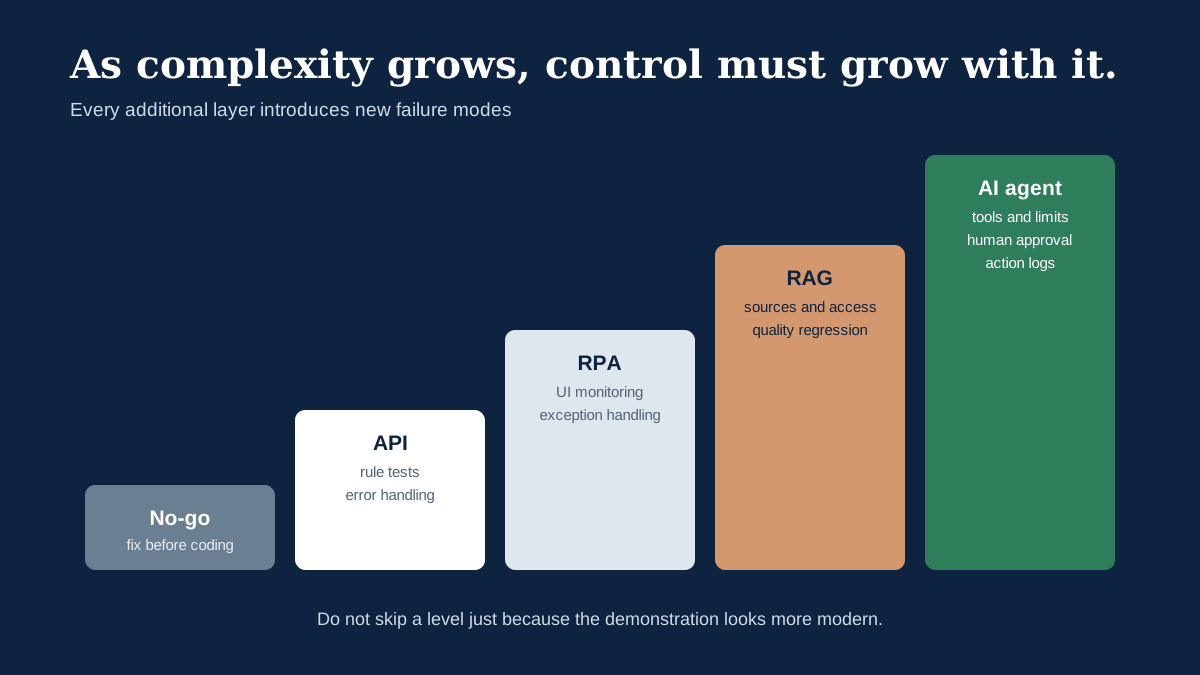
The relevant cost is not just the initial build. Include integration maintenance, interface changes, knowledge updates, evaluation, exception handling and process ownership. APIs need version management. RPA needs repair after UI changes. RAG needs source refreshes and quality regression tests. Agents additionally need tool, permission and action controls.
There is no honest fixed price without knowing the process. Our guide to AI agent and RAG costs breaks the scope into components. A separate decision is whether to buy an existing product or build a tailored system.
Common mechanism-selection errors
Starting with a tool. “We want an agent” is not a problem statement. Define the outcome, exceptions and cost of error first.
Confusing the interface with the architecture. A chat interface may trigger a fixed rule, RAG or an agent. Its appearance proves nothing about the underlying mechanism.
Adding a model to a deterministic decision. If the condition is “status equals approved”, a language model does not improve the rule.
Ignoring the safe failure path. Every mechanism can fail. What changes is the failure mode and the route back to control.
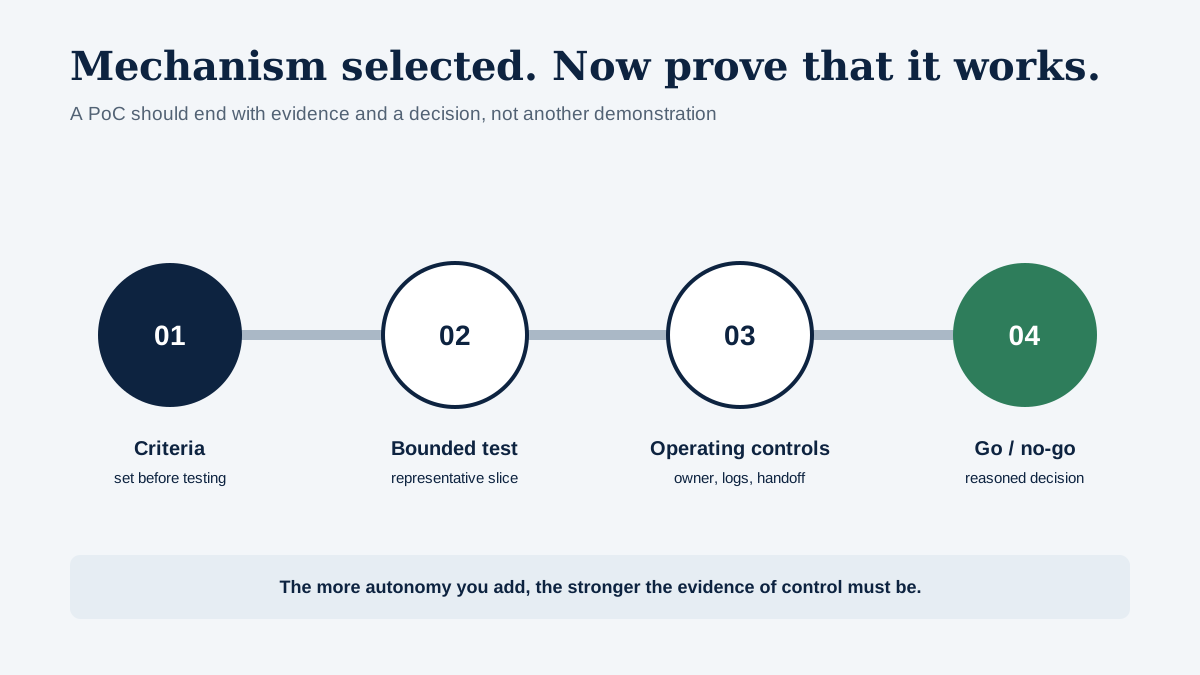
Scaling before testing. Start with a representative slice and acceptance criteria set in advance. A safe AI PoC is designed for exactly that purpose.
What to do before a PoC
Complete the free AI readiness scorecard. It assesses the process, data, shadow AI, ownership, risk, governance and readiness for a bounded PoC. It does not choose the mechanism for you and it is not a conformity assessment. Its purpose is to show whether the organisation can test one use case safely.
Once the problem and mechanism are clear, our AI vendor selection guide helps you check whether a supplier can document quality, limitations and responsibility. Only then should the work move to a PoC that ends with measured evidence and an honest go/no-go decision.